Publications
Research Highlights
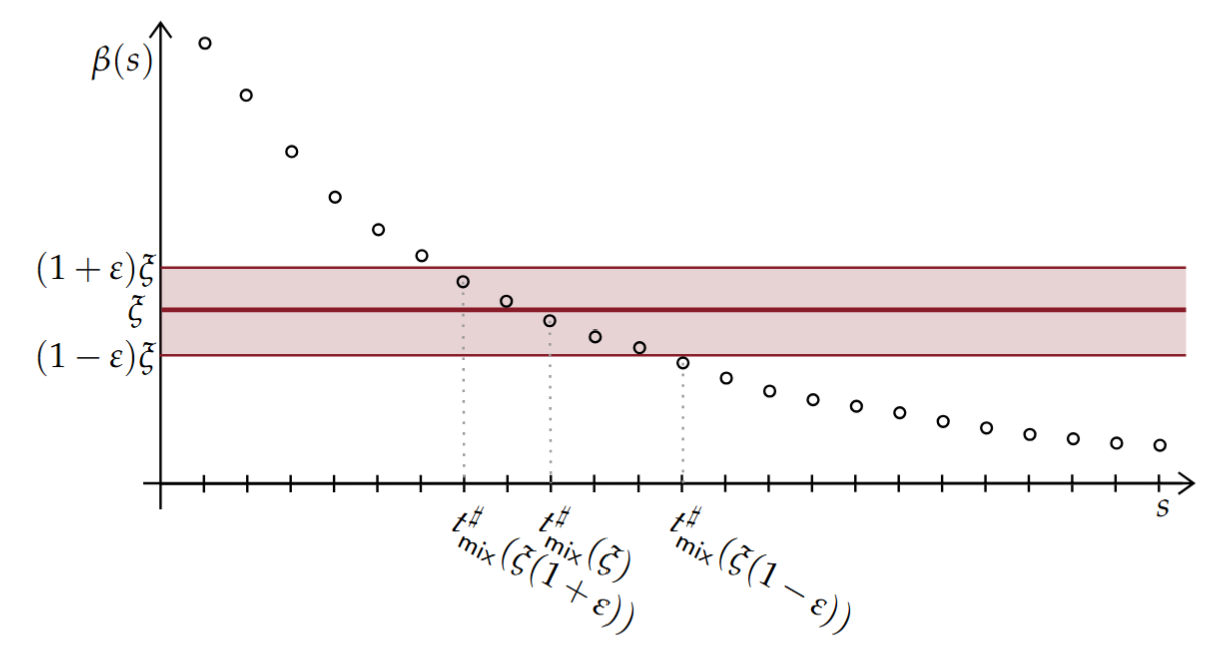
The convergence rate of a Markov chain to its stationary distribution is typically assessed using the concept of total variation mixing time. However, this worst-case measure often yields pessimistic estimates and is challenging to infer from observations. In this paper, we advocate for the use of the average-mixing time as a more optimistic and demonstrably easier-to-estimate alternative. We further illustrate its applicability across a range of settings, from two-point to countable spaces, and discuss some practical implications.
G. Wolfer and P. Alquier
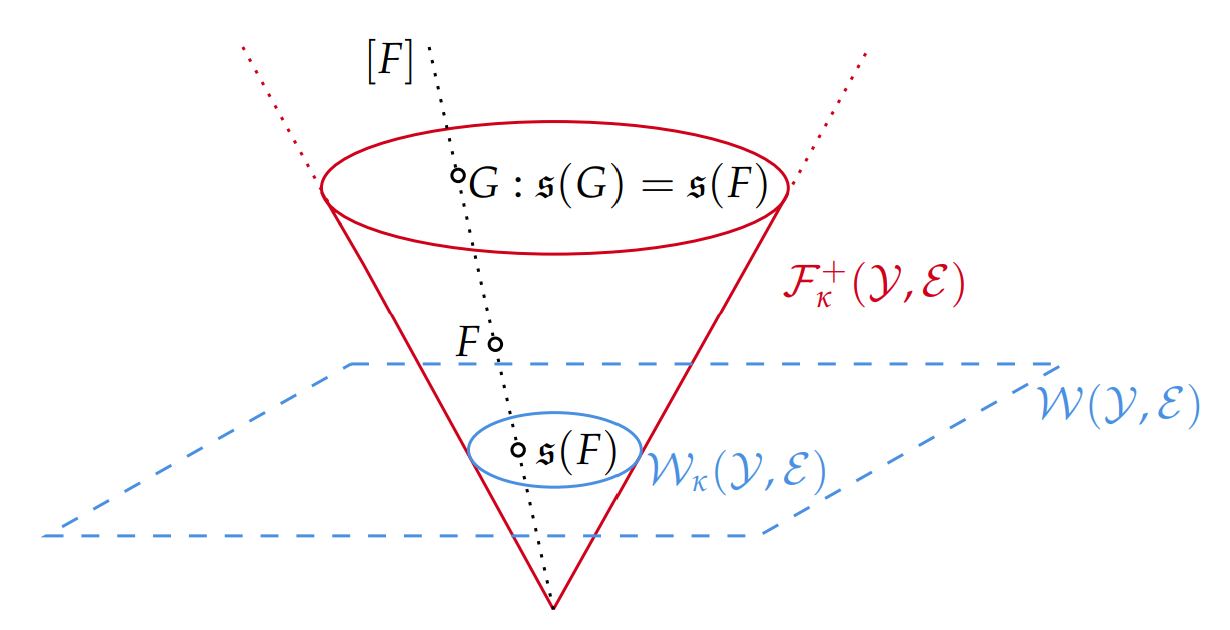
It is known that the set of lumpable Markov chains over a finite state space, with respect to a fixed lumping function, generally does not form an exponential family of stochastic matrices. In this work, we explore efficiently verifiable necessary and sufficient conditions for families of lumpable transition matrices to form exponential families. To this end, we develop a broadly applicable dimension-based method for determining whether a given family of stochastic matrices forms an exponential family.
S. Watanabe and G. Wolfer
Full Publication List
@article{ww2026,
  author = {Watanabe, Shun and Wolfer, Geoffrey},
  journal = {Information Geometry},
  title = {Characterization of Exponential Families of Lumpable Stochastic Matrices},
  year = {2026},
  month = {4},
  doi = {10.1007/s41884-026-00194-7},
  url = {https://doi.org/10.1007/s41884-026-00194-7},
  publisher = {Springer}
}
@article{choi2026geometry,
  title = {Geometry and Factorization of Multivariate {M}arkov Chains with Applications to {MCMC} Acceleration and Approximate Inference},
  author = {Choi, Michael C. H. and Wang, Youjia and Wolfer, Geoffrey},
  journal = {SIAM/ASA Journal on Uncertainty Quantification},
  year = {2026+},
  note = {To appear},
  eprint = {2404.12589},
  archivePrefix = {arXiv}
}